Start with the question
What do you need to know before trial?
Live mock juries are valuable because they show you what real people question,
which facts they remember, and where a case story becomes difficult to follow.
But they are expensive to convene and often leave you with a broad answer: what did
this particular room think?
OptoJury is built for the work between those sessions. Pressure-test alternate stories,
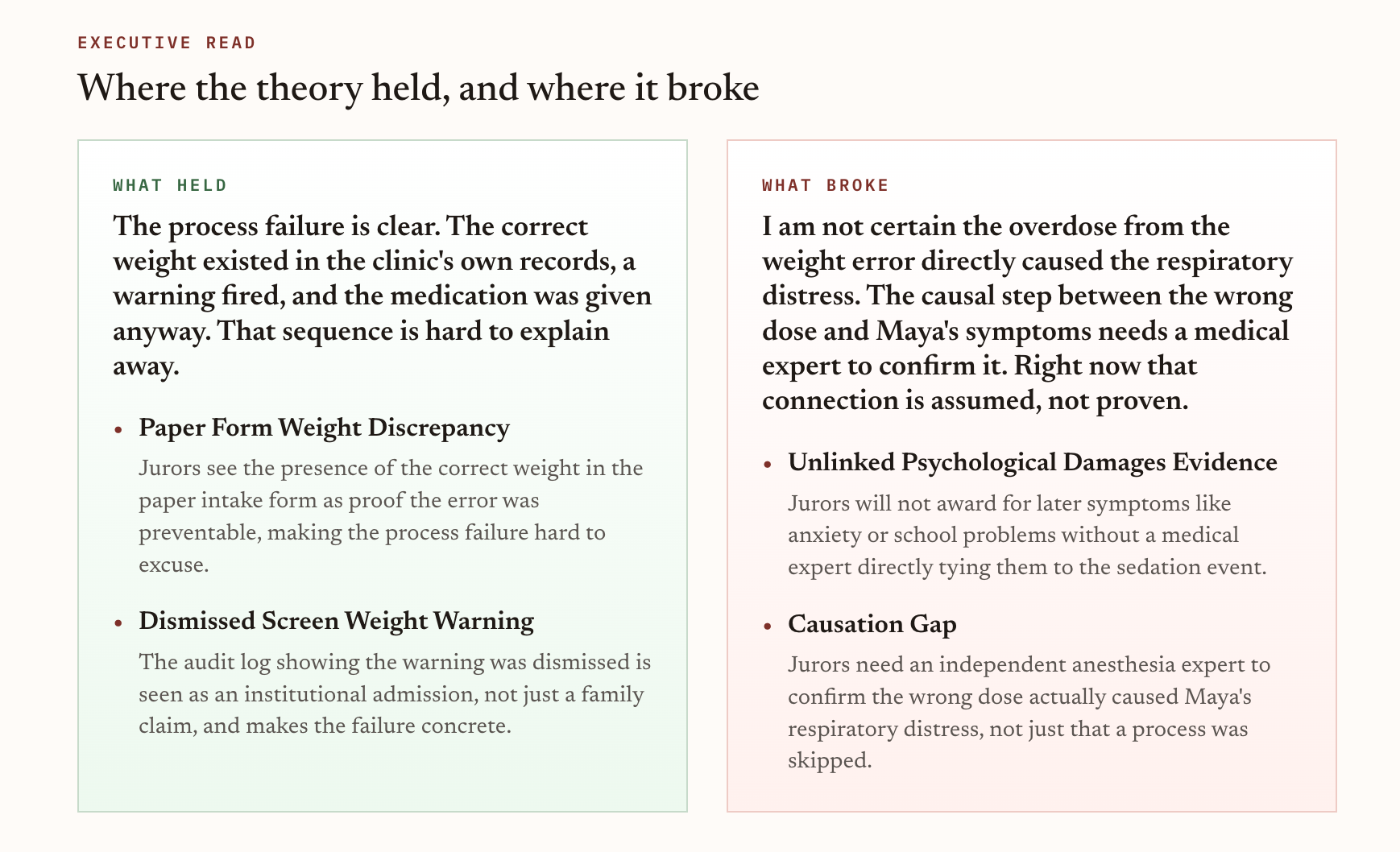
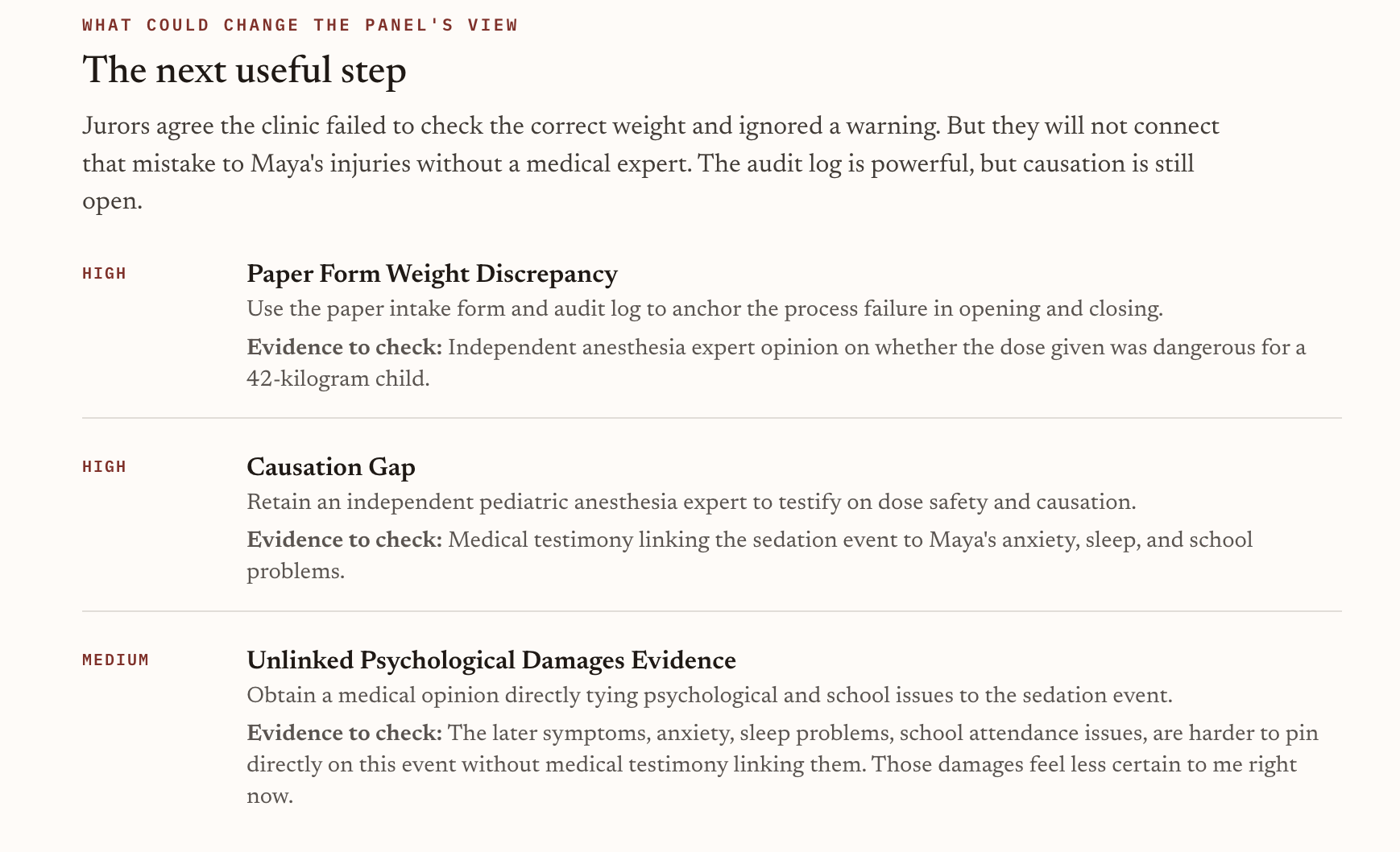
isolate the fact that moves a holdout, and turn uncertainty into a concrete preparation
list. It does not replace live mock-jury research; it helps you decide what to test next
and arrive better prepared.
01
Make the story clear
Can the panel follow the order of events?
02
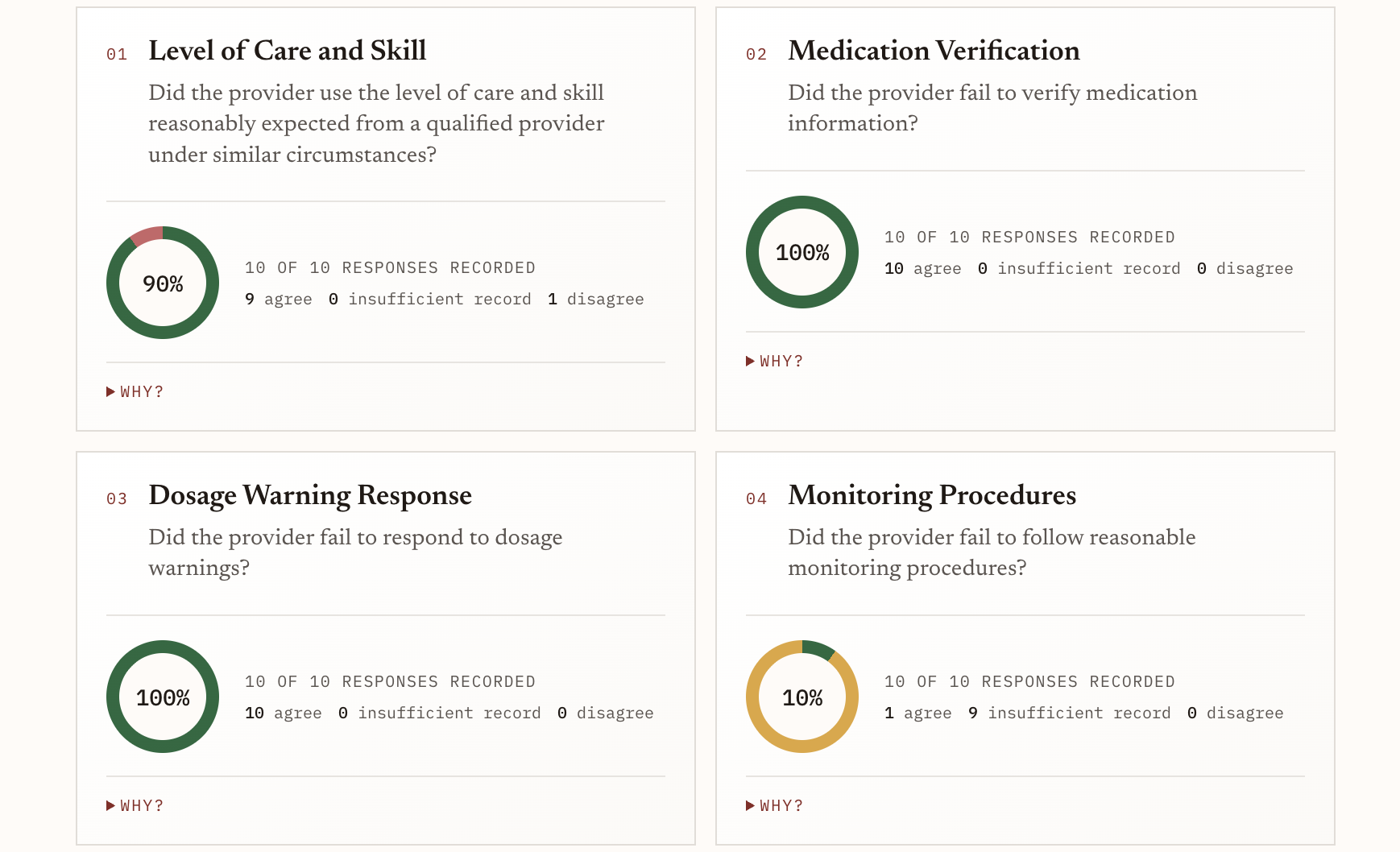
Find the hesitation
Which facts create doubt or movement?
03
Close the proof gap
What document or witness would help?
04
Calibrate the number
How might the damages story land?
| The question lawyers ask |
OptoJury |
Real mock jury |
Asking GPT |
| How quickly can I test a case theory? |
Run a structured panel read when the story changes, without scheduling a room. |
Requires recruiting, briefing, scheduling, and facilitating participants. |
Usually immediate, but the answer depends heavily on how the prompt is framed. |
| Can I compare two credible narratives? |
Yes. Test both stories against the same case record and compare where reactions diverge. |
Yes, but each version takes more time to prepare and control in the room. |
It can compare text, but it does not provide an independent panel response. |
| Does it reflect the place where the case will be heard? |
Uses state and county population context to shape the modeled panel. |
Depends on who is recruited and how closely the group matches the venue. |
General knowledge is not a statistically modeled local jury. |
| What kind of signal do I get? |
Recurring concerns, holdouts, proof gaps, narrative movement, and what could change a view. |
Rich live discussion, questions, body language, and unexpected group dynamics. |
Drafting help, issue spotting, and a fast outside perspective on the material provided. |
| Can I repeat the test as the case develops? |
Yes. Re-run after new evidence, a revised opening, or a different narrative. |
Possible, but each session adds recruiting and facilitation cost. |
Yes, though responses can vary with the prompt and model context. |
| What does a first pass cost? |
One case credit for a 10-juror panel, about $150 at $15 per juror. |
For 10 people, roughly $750–$1,000 for a half day or $1,500–$2,000 for a full day, before other logistics. |
Often included in a general AI subscription, but it is not a recruited or modeled jury panel. |
| When is it the strongest fit? |
Between major research sessions, when you need a concrete next preparation move. |
When you need deep live qualitative research and can support the logistics. |
When you need to organize facts, draft language, or explore an early question. |
Illustrative comparison based on a 10-person panel and the stated participant rates; recruiting, venue, moderation, and other mock-jury costs vary. These tools answer different questions. OptoJury is designed to help lawyers decide what to test, strengthen, or prepare next; it is not a substitute for live research or legal judgment.